
XG1

Modular UWB-PN-Sequence Sensor for Compressive Sensing and True MIMO Applications
Modular UWB-PN-Sequence Sensor for Compressive Sensing and True MIMO Applications

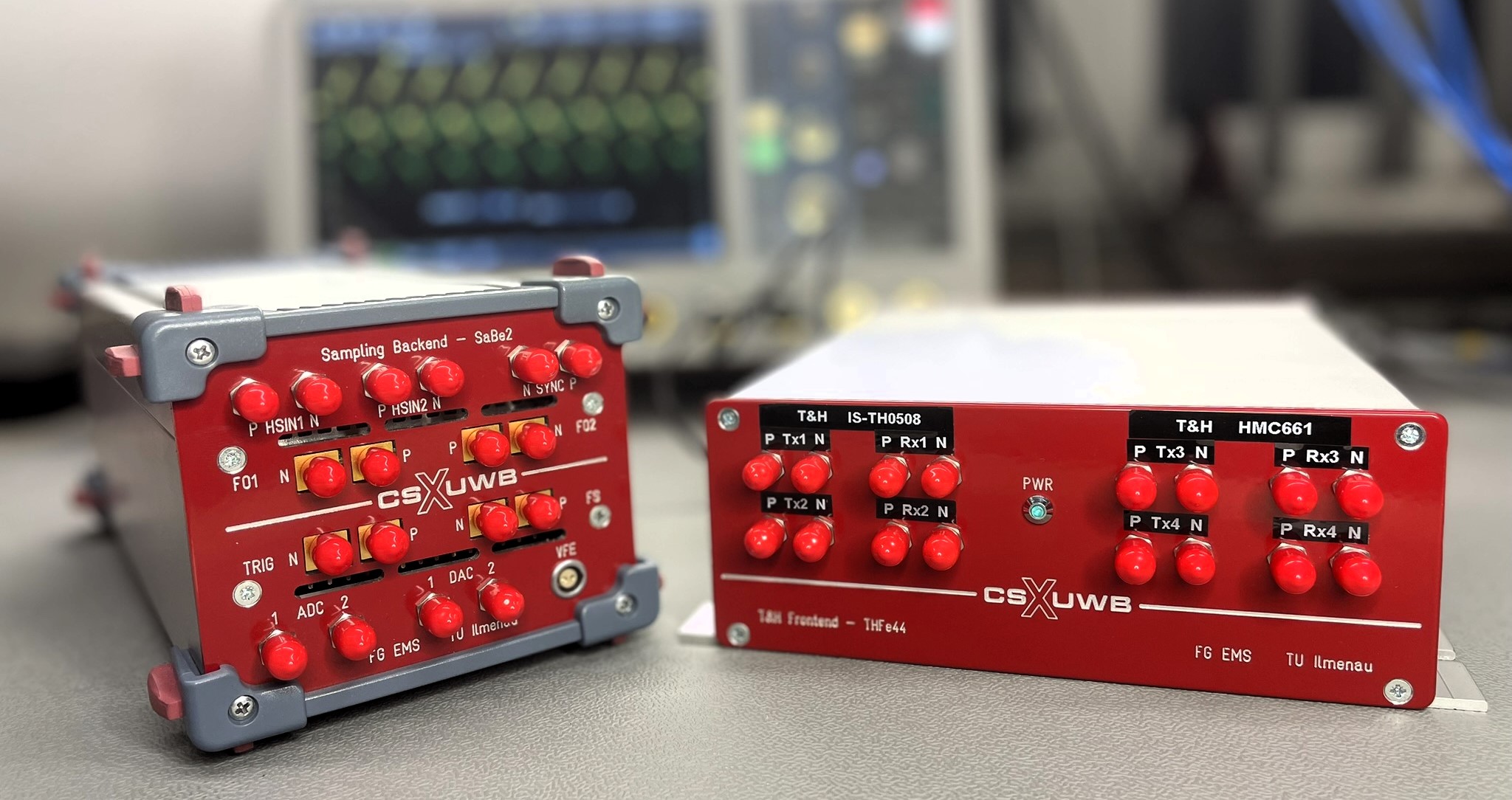
The modular ultra-wideband (UWB) pseudo noise (PN)-sequence sensor was introduced to showcase the capabilities of the EMS-developed integrated circuits (ICs) Xampling Generator 1 (XG1) and Xampling Frontend 1 (XF1) which were specifically designed to demonstrate the paradigm of compressive sampling implemented on real silicon hardware1. The sensor system divides into two main units - modular multiple input and multiple output (MIMO) transceiver (TRx) frontend and corresponding data acquisition backend.
Configurable Pseudo Noise Radar Imaging System Enabling Synchronous MIMO Channel Extension

Configurable Pseudo Noise Radar Imaging System Enabling Synchronous MIMO Channel Extension

Bräunlich, Niklas and Wagner, Christoph W. and Sachs, Jürgen and Del Galdo, Giovanni.

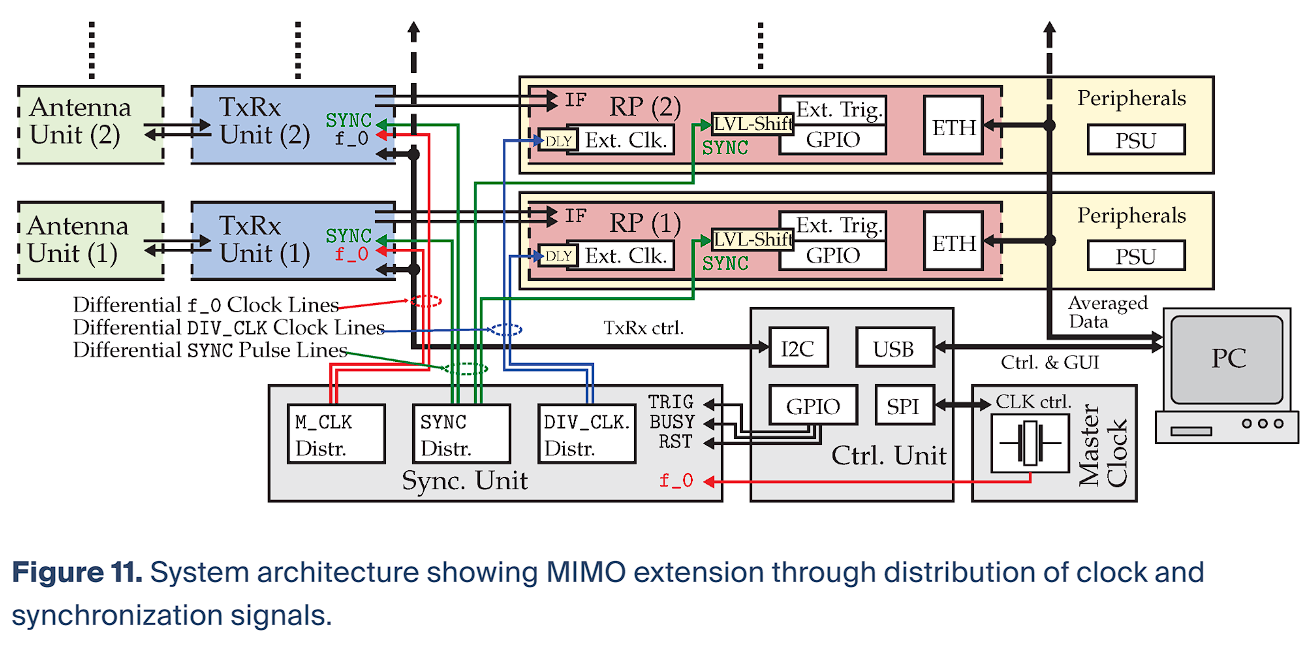
In this article, we propose an evolved system design approach to ultra-wideband (UWB) radar based on pseudo-random noise (PRN) sequences, the key features of which are its user-adaptability to meet the demands provided by desired microwave imaging applications and its multichannel scalability. In light of providing a fully synchronized multichannel radar imaging system for short-range imaging as mine detection, non-destructive testing (NDT) or medical imaging, the advanced system architecture is presented with a special focus put on the implemented synchronization mechanism and clocking scheme. The core of the targeted adaptivity is provided by means of hardware, such as variable clock generators and dividers as well as programmable PRN generators.

Hardware Architecture for Ultra-Wideband Channel Impulse Response Measurements Using Compressed Sensing

Hardware Architecture for Ultra-Wideband Channel Impulse Response Measurements Using Compressed Sensing

Wagner, Christoph W. and Semper, Sebastian and Römer, Florian and Schönfeld, Anna and Del Galdo, Giovanni.

We propose a compact hardware architecture for measuring sparse channel impulse responses (IR) by extending the M-Sequence ultra-wideband (UWB) measurement principle with the concept of compressed sensing. A channel is excited with a periodic M-sequence and its response signal is observed using a Random Demodulator (RD), which observes pseudo-random linear combinations of the response signal at a rate significantly lower than the measurement bandwidth. The excitation signal and the RD mixing signal are generated from compactly implementable Linear Feedback Shift registers (LFSR) and operated from a common clock. A linear model is derived that allows retrieving an IR from a set of observations using Sparse-Signal-Recovery (SSR).