
Compressed Sensing

Modular UWB-PN-Sequence Sensor for Compressive Sensing and True MIMO Applications
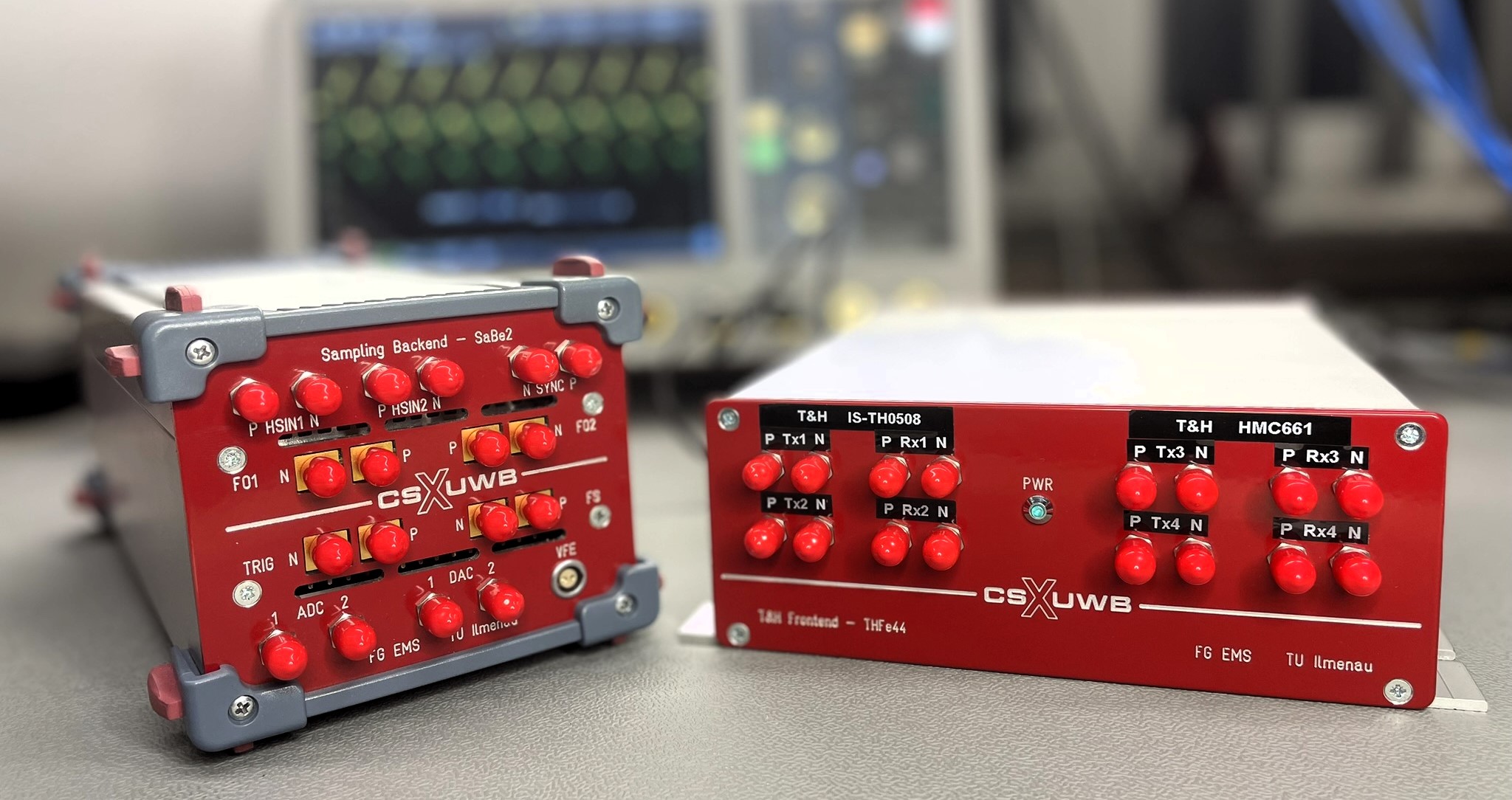
Modular UWB-PN-Sequence Sensor for Compressive Sensing and True MIMO Applications

The modular ultra-wideband (UWB) pseudo noise (PN)-sequence sensor was introduced to showcase the capabilities of the EMS-developed integrated circuits (ICs) Xampling Generator 1 (XG1) and Xampling Frontend 1 (XF1) which were specifically designed to demonstrate the paradigm of compressive sampling implemented on real silicon hardware1. The sensor system divides into two main units - modular multiple input and multiple output (MIMO) transceiver (TRx) frontend and corresponding data acquisition backend.

Hardware Architecture for Ultra-Wideband Channel Impulse Response Measurements Using Compressed Sensing

Hardware Architecture for Ultra-Wideband Channel Impulse Response Measurements Using Compressed Sensing

Wagner, Christoph W. and Semper, Sebastian and Römer, Florian and Schönfeld, Anna and Del Galdo, Giovanni.

We propose a compact hardware architecture for measuring sparse channel impulse responses (IR) by extending the M-Sequence ultra-wideband (UWB) measurement principle with the concept of compressed sensing. A channel is excited with a periodic M-sequence and its response signal is observed using a Random Demodulator (RD), which observes pseudo-random linear combinations of the response signal at a rate significantly lower than the measurement bandwidth. The excitation signal and the RD mixing signal are generated from compactly implementable Linear Feedback Shift registers (LFSR) and operated from a common clock. A linear model is derived that allows retrieving an IR from a set of observations using Sparse-Signal-Recovery (SSR).

Measurement Matrix Optimization for Compressed Parameter Estimation

When making use of the Compressed Sensing (CS) paradigm, one has to design the measurement process by means of a suitable compression step. Traditionally, the compression is modelled by means of a linear mapping acting on discretized version of the encountered signals, i.e. a usually complex-valued matrix 1 2 3. Also, it has been an active field of research to apply CS as a data reduction scheme in radio channel sounding 4. Afterwards one is confronted with the problem to recover the parameters of interest, like time-of-flight, direction-of-arrival or Doppler-shifts from spectral-, spatial- and temporal measurements of a radio channel. In this context the iterative maximum-likelihood approach in 4 presents an optimization approach that is both computationally feasible and reproduces closely what is dictated by the Cramer-Rao-Lower-Bound (CRLB).

The Theory of Finite Fields for Optimized Compressed Sensing Schemes

It has been shown1 that Linear Feedback Shift Registers (LFSR) can serve as a Radar sensor by random demodulation that enables significantly lower data-rates than dictated by the Nyquist-Sampling Theorem. At the same time they can be implemented very efficiently in silicon, while still allowing high configurability. This makes this approach a prime candidate for a wide range of Radar and inspection applications, but it requires a thorough study of the resulting theoretically achieveable performance.