Paper

Configurable Pseudo Noise Radar Imaging System Enabling Synchronous MIMO Channel Extension
Configurable Pseudo Noise Radar Imaging System Enabling Synchronous MIMO Channel Extension

Bräunlich, Niklas and Wagner, Christoph W. and Sachs, Jürgen and Del Galdo, Giovanni.

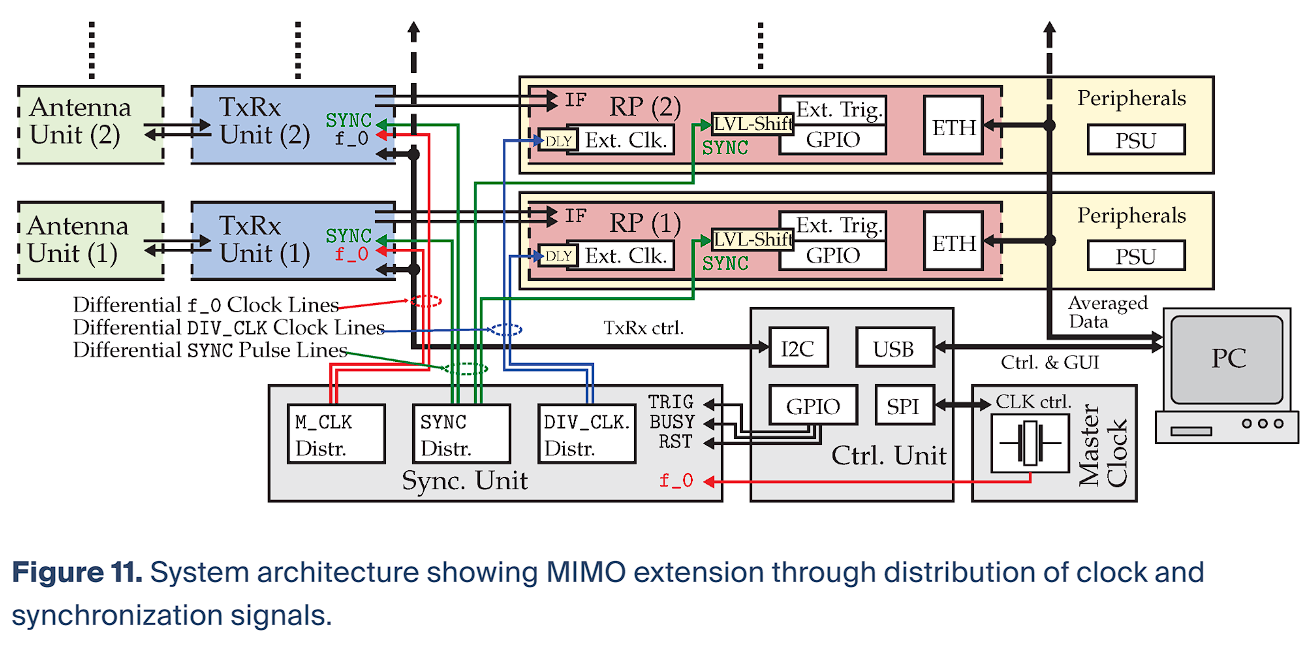
In this article, we propose an evolved system design approach to ultra-wideband (UWB) radar based on pseudo-random noise (PRN) sequences, the key features of which are its user-adaptability to meet the demands provided by desired microwave imaging applications and its multichannel scalability. In light of providing a fully synchronized multichannel radar imaging system for short-range imaging as mine detection, non-destructive testing (NDT) or medical imaging, the advanced system architecture is presented with a special focus put on the implemented synchronization mechanism and clocking scheme. The core of the targeted adaptivity is provided by means of hardware, such as variable clock generators and dividers as well as programmable PRN generators.

Hardware Architecture for Ultra-Wideband Channel Impulse Response Measurements Using Compressed Sensing

Hardware Architecture for Ultra-Wideband Channel Impulse Response Measurements Using Compressed Sensing

Wagner, Christoph W. and Semper, Sebastian and Römer, Florian and Schönfeld, Anna and Del Galdo, Giovanni.

We propose a compact hardware architecture for measuring sparse channel impulse responses (IR) by extending the M-Sequence ultra-wideband (UWB) measurement principle with the concept of compressed sensing. A channel is excited with a periodic M-sequence and its response signal is observed using a Random Demodulator (RD), which observes pseudo-random linear combinations of the response signal at a rate significantly lower than the measurement bandwidth. The excitation signal and the RD mixing signal are generated from compactly implementable Linear Feedback Shift registers (LFSR) and operated from a common clock. A linear model is derived that allows retrieving an IR from a set of observations using Sparse-Signal-Recovery (SSR).

Modeling Micro-Doppler Signature of Multi-Propeller Drones in Distributed ISAC

Modeling Micro-Doppler Signature of Multi-Propeller Drones in Distributed ISAC

Costa, Heraldo C. A. and Myint, Saw J. and Andrich, Carsten and Giehl, Sebastian W. and Engelhardt, Maximilian and Schneider, Christian and Thomä, Reiner S.

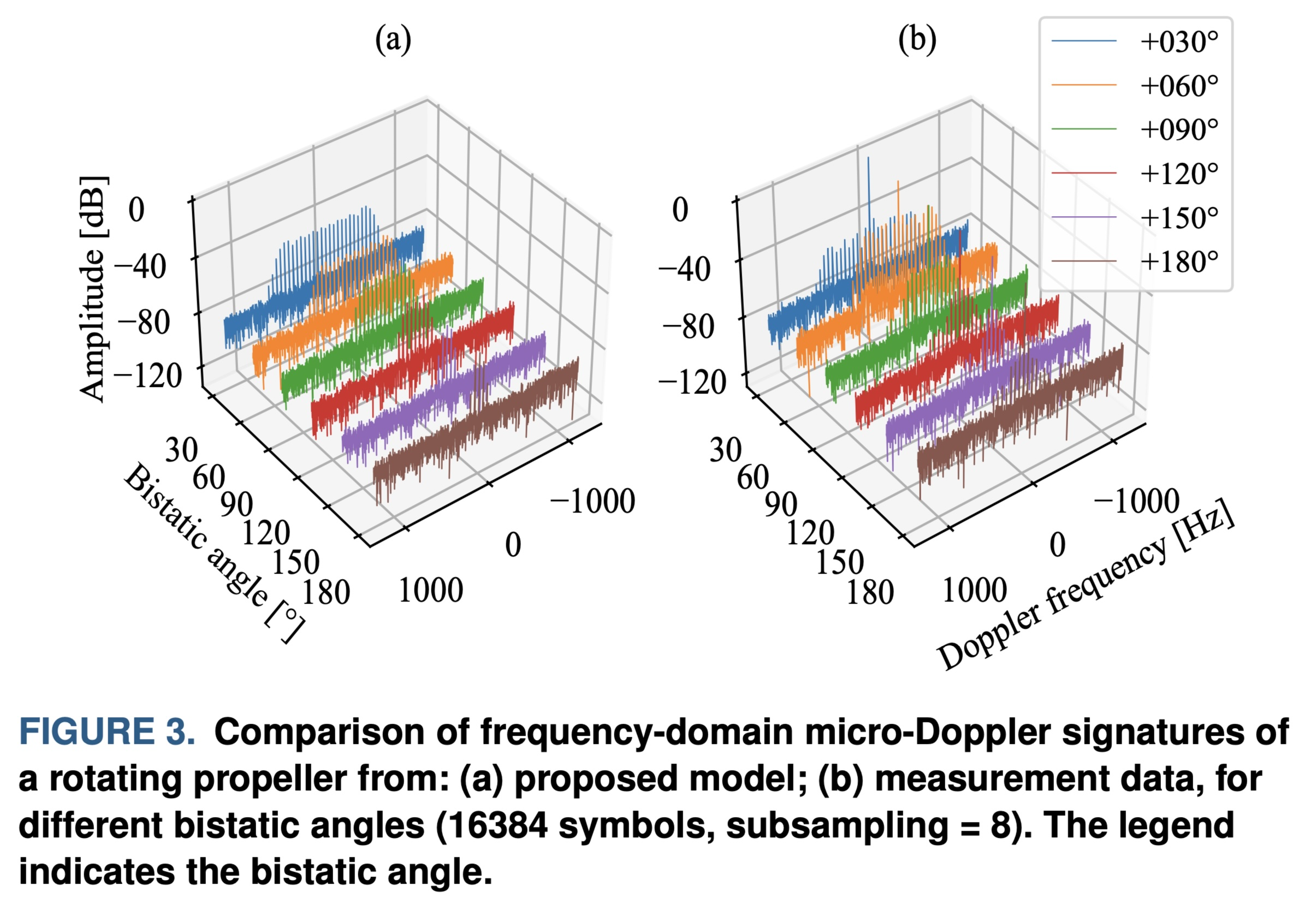
Integrated Sensing and Communication (ISAC) will be one key feature of future 6G networks, enabling simultaneous communication and radar sensing. The radar sensing geometry of ISAC will be multistatic since that corresponds to the common distributed structure of a mobile communication network. Within this framework, micro-Doppler analysis plays a vital role in classifying targets based on their micromotions, such as rotating propellers, vibration, or moving limbs. However, research on bistatic micro-Doppler effects, particularly in ISAC systems utilizing OFDM waveforms, remains limited.

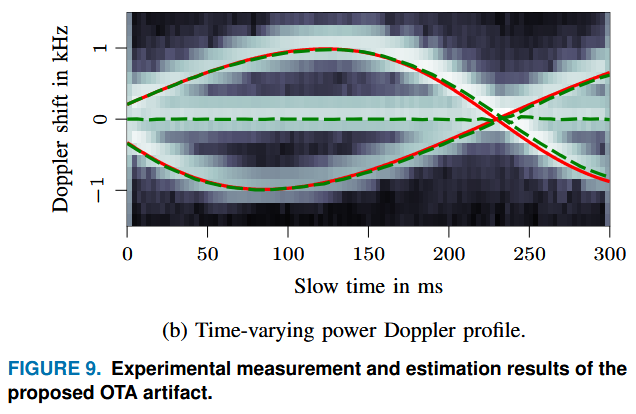
Metrology of Multicarrier-based Delay-Doppler Channel Sounding for sub-THz Frequencies

Metrology of Multicarrier-based Delay-Doppler Channel Sounding for sub-THz Frequencies

Jonas Gedschold; Diego Dupleich; Sebastian Semper; Michael Döbereiner; Alexander Ebert; Giovanni Del Galdo

Developing channel models typically requires aggregating channel measurements and the corresponding extracted propagation parameters from different research institutions to form a sufficiently large data basis. However, uncertainties arising from limitations of the sounding hardware and algorithms may greatly impact the comparability between sounding results. Especially, (sub-)THz channel sounders do not allow simultaneous spatially and timely resolved measurements as known from sub-6 GHz and mm-wave applications (right now), limiting the possibilities of a hardware-independent channel characterization. At the same time, a high Doppler bandwidth may occur due to the high carrier frequencies, limiting the time spans for coherent or incoherent data processing. Hence, assessing the sounder’s performance and limits is important before interpreting the measurement results.

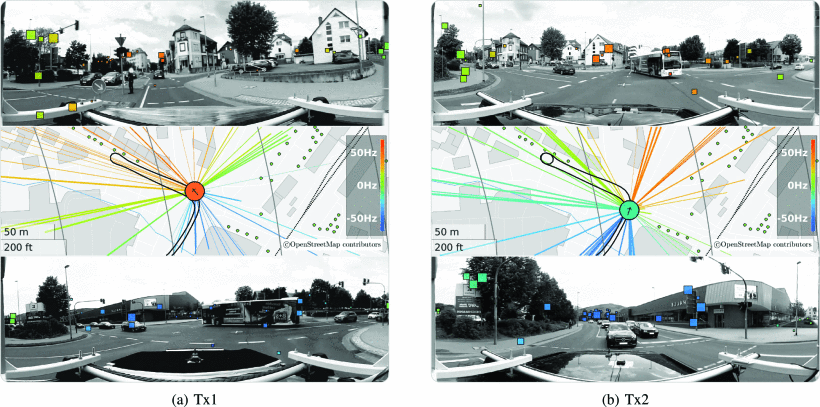
Time Variant Directional Multi-Link Channel Sounding and Estimation for V2X

Time Variant Directional Multi-Link Channel Sounding and Estimation for V2X

Stanko, Daniel and Döbereiner, Michael and Sommerkorn, Gerd and Czaniera, Daniel and Andrich, Carsten and Schneider, Christian and Semper, Sebastian and Ihlow, Alexander and Landmann, Markus

We present our new scalable multi-channel and multi-node sounder, the ILMSound G3. It is configurable in terms of the number of switched Tx and parallel Rx nodes. The basic structures of the Tx and Rx nodes are given with consideration of the measurement system requirements. The ILMSound G3 is validated via a proof of concept measurement at 2.53 GHz in an urban environment.